
'Historically, equities have consistently outperformed debt, gold, property, and other assets over a reasonable period.'

Benchmark Sensex closed above the 85,000 level for the first time while Nifty scaled the 26,000 peak at close on Wednesday as fag-end buying in banking and power shares helped stock markets recoup early losses. After a see-saw trade during the day, the 30-share BSE Sensex rose by 255.83 points or 0.30 per cent to settle at an all-time high of 85,169.87. During the day, it surged 333.38 points or 0.39 per cent to hit a record intra-day peak of 85,247.42.

Morgan Stanley has increased the target prices of certain information technology (IT) stocks by as much as 29 per cent, anticipating an improvement in earnings in the near future. Within the IT and engineering research and development (ER&D) services sector, it is now more optimistic about growth and margin estimates for 2024-25 (FY25).

Benchmark BSE Sensex rebounded sharply by 941 points while NSE Nifty closed above the 22,600 level on Monday on the back of buying in banking and infra shares and a global stocks rally. The 30-share BSE Sensex jumped 941.12 points or 1.28 per cent to settle at 74,671.28. During the day, it zoomed 990.99 points or 1.34 per cent to 74,721.15.

From the Sensex basket, Mahindra & Mahindra, Tata Motors, NTPC, HCL Technologies, Larsen & Toubro, Infosys, Tech Mahindra and State Bank of India were the major laggards. Bharti Airtel, Bajaj Finance, Bajaj Finserv, Tata Consultancy Services and IndusInd Bank were among the gainers.

'It will be a cat and mouse game between investors and the government.' 'The issue will be launched only if there is sufficient demand from investors and the government is in agreement with the bankers on the valuations.'
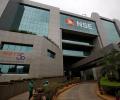
FPIs' ownership in NSE-listed companies reached a five-year high of 22.74 per cent in December 2020 on the back of huge net inflow of Rs 1.42 lakh crore by such investors in the third quarter.

Unabated buying by domestic institutional investors and wholesale price inflation falling to 2.60 per cent in September, helped both the key indices to scale new highs.

Among the Sensex firms, State Bank of India rose the most by 3.78 per cent after the bank announced the acquisition of SBI CAPS subsidiary for Rs 708.07 crore. Nestle India gained 1.68 per cent after it reported around 9 per cent growth in sales. JSW Steel, Bajaj Finance, Axis Bank and Asian Paints were among the gainers.

Dalal Street investors became richer by more than Rs 16.36 lakh crore this year as the equity market scaled new highs despite persistent geopolitical uncertainties and inflation worries. Analysts attributed better macroeconomic fundamentals, the confidence of retail investors and foreign investors investing again in the domestic equities towards the latter half of 2022 as the key factors that led to the outperformance of the Indian market in comparison to many other stock markets worldwide. During the initial part of the year, markets were jolted by the Russia-Ukraine war.

Institutional buying/selling activity shows domestic institutions were aggressively selling, whereas foreign institutional investors were seen lapping up stocks.

Top losers in the session included Maruti, Tata Motors, RIL, Yes Bank, Adani Ports, Bharti Airtel, Asian Paints, ONGC, HUL, Kotak Bank, IndusInd Bank and Axis Bank, falling up to 5 per cent.

Equity benchmark index Sensex on Wednesday crashed over 900 points to sink below the 73,000 level due to widespread selling pressure amid a sharp fall in smallcap and midcap indices. Besides, deep losses in utility, energy and metal stocks and recent selling by foreign investors added to the gloom, analysts said. Benchmark indices started the session on a positive note, but the selling intensified during afternoon trade, with all sectoral indices ending in the red.

Tata Motors was the biggest gainer in the Sensex pack, rallying 2.94 per cent. It was followed by Vedanta, Bajaj Finance, Sun Pharma, ONGC, ICICI Bank, Bajaj Auto, Tata Steel, RIL, HDFC duo, L&T and SBI, rising up to 2.78 per cent.

Among the Sensex firms, Larsen & Toubro, Axis Bank, Tata Steel, Bajaj Finance, Power Grid, Asian Paints, Mahindra & Mahindra and Bajaj Finserv were the biggest gainers. State Bank of India, Hindustan Unilever, Tata Motors and Titan were the laggards.

'A key reason for the strong interest in IPOs has been an increased focus on profitability and reasonable pricing of deals.'

The share of non-resident Indians (NRIs) and overseas investors in Indian mutual funds has been declining over time, despite adding half-a-trillion rupees to holdings over the last five years. Mutual fund holdings for the segment went up from Rs 0.95 trillion as of December 2018 to Rs 1.54 trillion as of December 2022, shows Business Standard analysis of data from the industry body Association of Mutual Funds in India (Amfi). Their share in overall mutual fund assets has fallen from 4.2 per cent to 3.9 per cent during the same period.
Anil Ambani group's Reliance Power appears to have failed to hold back a large number of foreign and domestic shareholders, even by offering bonus shares, yet it remains the most widely held entity in India.Among the institutional investors, a marked decline has been in the number of FIIs, while that of domestic institutions has also fell to 103, from 345 previously.

Among the Sensex firms, Asian Paints, Titan, Larsen & Toubro, JSW Steel, ITC, Hindustan Unilever, Maruti and Reliance Industries were the major gainers. ICICI Bank, NTPC, Infosys, Tech Mahindra, Tata Steel and Bajaj Finance were among the laggards.

The broader 50-issue NSE Nifty slipped from its record closing, shedding 2.30 points or 0.02 per cent to end at 11,132.00.

Since March 2020, when the Nifty50 plummeted to 7,511 following the announcement of a nationwide lockdown, the stock market has been on an upward trajectory. Over the next four years, the major market index has delivered a remarkable compounded annual growth rate (CAGR) of over 31.5 per cent. In the past year alone, the Nifty50 has gained by 27 per cent, hitting a succession of record highs.

HCL Technologies was the biggest gainer in the Sensex pack, rising 5.58 per cent, followed by Tata Consultancy Services and Infosys, State Bank of India, Tech Mahindra, Tata Steel, NTPC and Wipro. In contrast, Nestle, Bharti Airtel, Maruti and ITC were among the laggards.

The Sensex was mainly dragged by Reliance Industries, HDFC, HDFC Bank, ICICI Bank and SBI, which lost up to 3.35 per cent.

Appreciating rupee against the dollar and fresh buying by domestic institutional investors added to the momentum

The 50-share NSE Nifty after moving between 10,374.30 and 10,307.30 settled flat at 10,348.75, up 6.45 points, or 0.06 per cent.

The BSE benchmark Sensex rose 192 points to end at 39,250 on Sunday as investors built up fresh positions in the special Muhurat trading session to mark the beginning of Hindu Samvat year 2076.

Among the Sensex firms, IndusInd Bank, Tata Steel, Tata Motors, Sun Pharma, Infosys, Mahindra & Mahindra, Infosys, NTPC, Bharti Airtel, HCL Technologies and Axis Bank were the biggest gainers. Tech Mahindra and Bajaj Finance were the laggards.

Domestic households are grossly underexposed to equities.

Reliance Industries was the biggest gainer in the Sensex pack, rising 2.69 per cent, followed by HCL Tech, ICICI Bank, Tata Motors, Wipro, IndusInd Bank, JSW Steel, Wipro, Tata Consultancy Services and Titan. In contrast, NTPC, Power Grid, UltraTech Cement, Axis Bank, Infosys and Nestle were the major laggards.

From the Sensex basket, Kotak Mahindra Bank, HCL Technologies, ICICI Bank, Infosys, Tata Consultancy Services, Wipro, Tech Mahindra and Larsen & Toubro were the major laggards. Mahindra & Mahindra, Nestle, Tata Motors and IndusInd Bank were among the gainers.

After withdrawing record funds in 2021-22, foreign portfolio investors (FPIs) continued their sell-off in the last fiscal too and pulled out Rs 37,631 crore from Indian equities amid aggressive rate hikes by central banks globally. The outflow trend is likely to reverse in the current financial year since India has the best growth potential in the financial year 2023-24 (FY24), VK Vijayakumar, chief investment strategist at Geojit Financial Services, said. Market analysts believe that FPI flows in the current financial year would be decided by a host of factors, such as the US Federal Reserve's policy stance, oil prices movement and development in the geopolitical situation.

Sustained FII inflows and fresh spell of buying by domestic institutional investors fuelled the rally
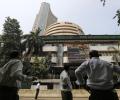
Continued capital inflows by foreign funds and retail investors kept market's mood upbeat, traders said.

The broader NSE Nifty, after slipping below the 10,500-mark to hit a low of 10,477, finally concluded 29 points, or 0.27 per cent, down at 10,524.

Domestic markets are also aided by a rally in the global markets with US market surging to record high and a firming trend at other Asian bourses.

The broader Nifty, after struggling, also managed to end above the 10,200-level.
ITC, L&T and banks like ICICI Bank, SBI and HDFC Bank aid the upmove.
Markets scripted a dramatic 547-point rebound from lows to close in the positive zone.

NTPC was the top gainer in the Sensex pack, rallying 3.44 per cent. Bharti Airtel, Bajaj Finance, TCS, HDFC twins, Yes Bank and RIL too gained up to 2.33 per cent.

The rupee depreciated 22 paise to a record low of 78.59 against the US dollar in opening trade on Tuesday as persistent foreign funds outflows weighed on investor sentiments. At the interbank foreign exchange, the rupee opened on a weak note at 78.53 against the American dollar, then lost ground to quote at 78.59 -- its all-time low level, registering a fall of 22 paise from the last close. On Monday, the rupee declined by 4 paise to close at its life-time low of 78.37 against the US dollar.
